Weather-Pro Pyranometer

|
||
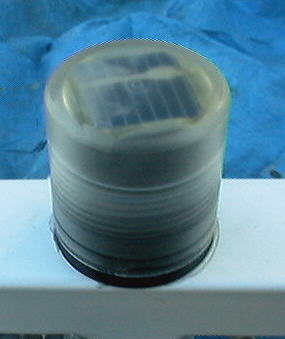
| The Weather-Pro Pyranometer uses an polycrystalline
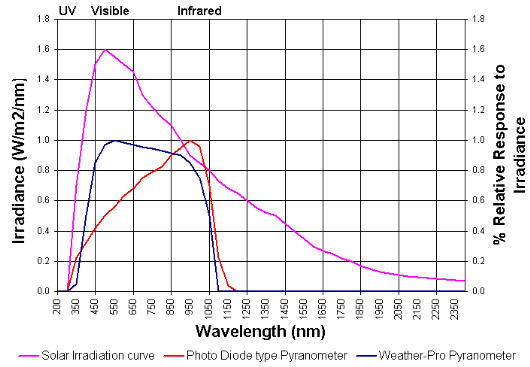
silicon solar cell to measure the incoming global solar radiation. The pyranometer gives good accuracy without the expense and maintenance required by a thermopile pyranometer. It also provides a flatter spectral response than the photo diodes that are frequently used for this type of sensor. (see spectral response graph). The Weather-Pro Pyranometer has a relatively large surface compared to many photo diode sensors. This minimizes inaccuracies caused by the effect of rain drops and dirt on the surface. The sensor has a slightly domed top to facilitate rain drainage. Dirt sitting on the surface of the sensor is dispersed by rain flowing off the dome. |
||
Spectral Response Graph
|
||
Spectral Response The full terrestrial solar spectrum
deposits measurable energy at the earth's surface in the range from 287 nanometers (nm) to
beyond 4000 nm. However, as can be seen from the spectral response
graph, the Weather-Pro Pyranometer measures the
radiation between 300 and 1100 nanometers. As over 90% of the solar energy is between 300
to 1100 nm, the Weather-Pro Pyranometer is calibrated so as to estimate the short-wave component of the solar
radiation. |
||
| Cosine Response Graph
|
||
| Cosine Response
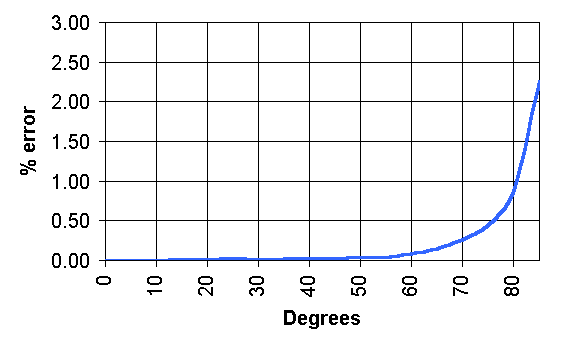
An ideal pyranometer collects radiation from horizon to horizon and should therefore have a reception angle of 180� in all directions. In reality, some low angle radiation will not be detected because of the geometry of the sensor but this has been minimized by the sensor head design. As can be seen from the cosine response graph, the cosine error for the Weather-Pro Pyranometer is typically less than 3% from vertical to 85� in all directions. |
||
Other sources of error. The polycrystalline silicon solar cells have a temperature coefficient of 0.15% per 1�C. The Weather-Pro Pyranometer is calibrated at 20�C giving a possible 3% error from 0�C to 40�C The output of all radiation
sensors tends to decrease over time as the detector ages. Our calculations estimate that
the average decrease of the sensor is between 1% and 2 % per year. |
 Email
Email Agents
 Weather-Pro-Std (no longer available)
 Features
 Standard Sensors
 Specification
 Weather-Pro-Plus (no longer available)
 Features
 Standard Sensors
 Specification
 Weather-Pro-RF
 Features
 Standard Sensors
 Specification
 Weather-Pro-GSM (no longer available)
 Features
 Standard Sensors
 Specification
 Comparisons
 Photo Gallery
 Rain Gauges
 Ground Temperature
 Leaf Wetness
 Low Wind Speed
 Soil Moisture % by Vol
 Soil Moisture Tension
 Radio Links
 Powered Probe Controller
 3 Meter Tower Kit
 Other Tower Options
 Extension Communications Cables
 Weather-Pro PC software
 PC Software Screenshots
 PC Software User Manual
 Weather Display Live Demo
 PC Software Install/Update
 Smartphone Apps
 Weather-Pro FAQ